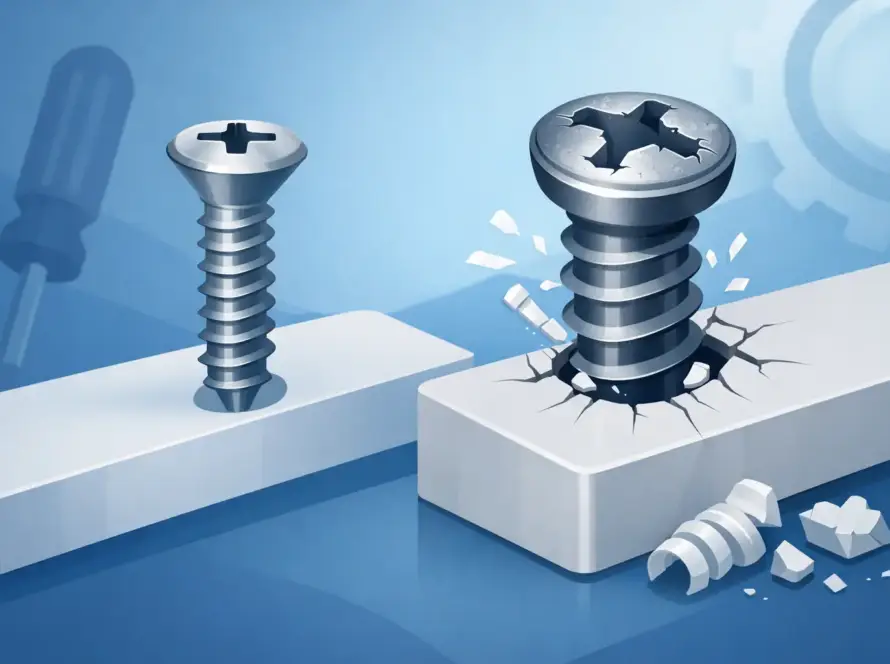
When a steel bracket is fixed to aluminum, or a thermoplastic housing is joined to a stainless insert, the fastener stops being a simple catalog item. In assemblies that combine metals, plastics, composites, or coated substrates, fasteners for dissimilar materials have to manage more than clamp force. They have to control galvanic potential, differential thermal expansion, local bearing stress, creep, vibration, and long-term service reliability.
For OEMs and industrial buyers, that changes the selection process. A screw that performs well in a steel-to-steel joint may drive premature corrosion in aluminum, crack a brittle plastic boss, or lose preload after thermal cycling. The right specification starts with the joint system, not the nominal diameter alone.
Why fasteners for dissimilar materials fail
Most field failures in mixed-material joints are predictable. The issue is rarely the fastener in isolation. It is the interaction between the fastener material, the joined substrates, the environment, and the installation method.
Galvanic corrosion is one of the first risks to assess. When two dissimilar metals are electrically connected in the presence of an electrolyte, the less noble material can corrode at an accelerated rate. A stainless steel fastener in aluminum may look attractive from a corrosion-resistance standpoint, but in wet or salt-laden conditions the aluminum can become the sacrificial material. In transportation, outdoor equipment, and infrastructure applications, that trade-off matters as much as static strength.
Loss of clamp load is another common issue. Mixed-material joints expand and contract at different rates under temperature change. Aluminum moves differently than steel. Plastics move far more than either. If the joint is not designed to absorb that movement, preload can drop, sealing can degrade, and vibration resistance can fall with it.
Then there is substrate damage. Thin sheet metal can deform under high localized load. Thermoplastics can strip if thread geometry is wrong. Fiber-reinforced composites may delaminate or crush around the hole if bearing stress is not controlled. In all three cases, the fastener may remain intact while the joint fails.
Material pairing matters more than catalog convenience
Specifying fasteners for dissimilar materials starts with the base materials on both sides of the joint. This is where many sourcing decisions either reduce risk early or build in future warranty costs.
Metal-to-metal combinations
Steel to aluminum is one of the most common mixed-material pairings in modern equipment. It is also one of the most sensitive. Zinc-plated carbon steel fasteners are often economical and mechanically suitable, but plating system, coating thickness, and environmental exposure need scrutiny. In some cases, isolation washers, surface treatments, or barrier coatings are necessary to reduce galvanic activity. Stainless can improve direct fastener corrosion resistance, but that does not automatically make it the best system choice if the aluminum becomes vulnerable.
For light alloys, clamp load distribution is critical. Softer substrates can deform under high seating stress, especially where small bearing surfaces are used. A flange head, captive washer arrangement, or engineered load-spreading feature can improve joint durability without increasing assembly complexity.
Metal-to-plastic joints
Fastening metal components into thermoplastics introduces a different set of constraints. The fastener must create secure thread engagement without overstressing the plastic during installation. Standard machine screws often perform poorly in direct-to-plastic applications because thread form is not optimized for material displacement and retention.
Thread-forming screws for thermoplastics are usually the better route. They are designed to reduce radial stress, improve boss fill, and support repeatable installation torque windows. Even then, it depends on resin type, glass fill, wall thickness, and service temperature. A screw that works in unfilled polypropylene may not be suitable in glass-filled nylon, where insertion forces, creep behavior, and crack sensitivity differ significantly.
Where long-term clamp retention matters, compression limiters can be essential. They prevent over-compression of the plastic substrate and help preserve clamp force when the joint is exposed to temperature swings or sustained load.
Composites and brittle materials
Composites demand caution because failure can be hidden until the joint is loaded in service. Hole quality, edge distance, and bearing area matter as much as fastener grade. If installation torque is too high, the laminate can crush or split. If too low, the joint can fret under dynamic load.
In these applications, fastening systems that control installation consistency and distribute load are often more valuable than simply moving to a stronger screw. High tensile strength in the fastener does not compensate for weak local substrate performance.
Joint design decisions that improve performance
Fastener selection cannot be separated from joint design. The most reliable mixed-material assemblies are engineered so the fastener, hole, substrate, and installation process work as one system.
Choose the right thread strategy
If the fastener engages a metal insert, machine screw geometry may be appropriate. If it forms a thread directly in plastic, the thread profile should be designed for that substrate. If thin sheet is involved, thread-forming or thread-cutting solutions for sheet metal may deliver better strip resistance and faster assembly than a general-purpose screw.
This is not just about pull-out values. Correct thread strategy also improves torque control, reduces installation variability, and lowers scrap in production.
Manage clamp load across soft and hard substrates
Dissimilar materials do not compress equally. In a joint that includes a soft layer and a rigid layer, clamp force concentrates where the system is weakest. Washers, flanged heads, bushings, or compression limiters can reduce peak stress and improve load distribution.
This is especially important where plastics are assembled to metal frames, covers are mounted to castings, or coated surfaces must remain intact. Without load management, the joint may pass initial assembly checks and still fail after thermal cycling or vibration exposure.
Plan for thermal expansion
A mixed-material joint that sees outdoor weather, engine heat, process heat, or cold storage conditions should be evaluated for expansion mismatch. The greater the temperature range, the more preload behavior matters.
Sometimes the answer is a different fastener material. Sometimes it is a washer stack, a spring element, or a revised grip length. In vibration-prone assemblies, anti-loosening features become even more important once thermal movement is part of the picture.
Corrosion control is a system decision
Corrosion performance in fasteners for dissimilar materials is often reduced to one question: stainless or plated steel? In practice, the decision is broader.
Coating compatibility, exposed edges, drainage, retained moisture, operating atmosphere, and service interval all influence joint life. A highly corrosion-resistant fastener can still create a poor system if it accelerates attack on the parent material. Conversely, a plated carbon steel fastener may perform well when paired with the right coating system, isolation method, and maintenance environment.
For transportation, agricultural equipment, marine-adjacent installations, and outdoor electrical housings, salt exposure changes the risk profile significantly. In indoor electronics or white goods, condensation and chemical cleaners may be the more relevant variables. The correct choice depends on how the full assembly actually lives in service.
Vibration, serviceability, and production speed
Many mixed-material joints are not static. They see shock, cyclic loading, and repeated maintenance. That shifts the specification toward retention performance and assembly repeatability.
If the joint will be removed for service, repeated installation into plastic or soft alloys can degrade the substrate. Threaded inserts, captive screw systems, or redesigned engagement zones may be justified even if they add cost at the component level. The alternative is a field failure or a housing that can no longer hold torque after a few service events.
For high-volume manufacturing, drive-system consistency matters too. Controlled installation, reduced cam-out, and stable torque transmission become more valuable when the assembly includes variable materials. Better drive engagement reduces cosmetic damage, improves tool control, and helps operators stay within process windows.
This is where engineered fastening support has practical value. Suppliers that understand not just fastener dimensions but application behavior can help reduce line issues, over-torque damage, and warranty-driven redesigns.
A practical specification approach
The fastest way to improve results is to evaluate the joint in five layers: substrate pair, environment, load case, assembly method, and service life. Start with the materials being joined and identify whether corrosion potential, creep, softness, or brittleness is the primary risk. Then review the operating environment, including moisture, chemicals, and temperature range.
Next, define the load case. Is the joint structural, cosmetic, sealing-related, or primarily positional? Does it see vibration, impact, or frequent disassembly? From there, match the fastener type and thread strategy to the actual assembly method, including hand installation, automated driving, prevailing torque requirements, and target cycle time.
Only after those steps should final material, coating, head style, and locking feature be set. That sequence usually produces a better answer than starting with whatever standard screw is already on the approved vendor list.
For buyers and engineers working across mixed substrates, the most effective fastener is rarely the cheapest line item. It is the one that protects the parent materials, holds preload, supports efficient assembly, and stays reliable in the real operating environment. That is the difference between a joint that merely goes together and one that stays engineered for the life of the product.