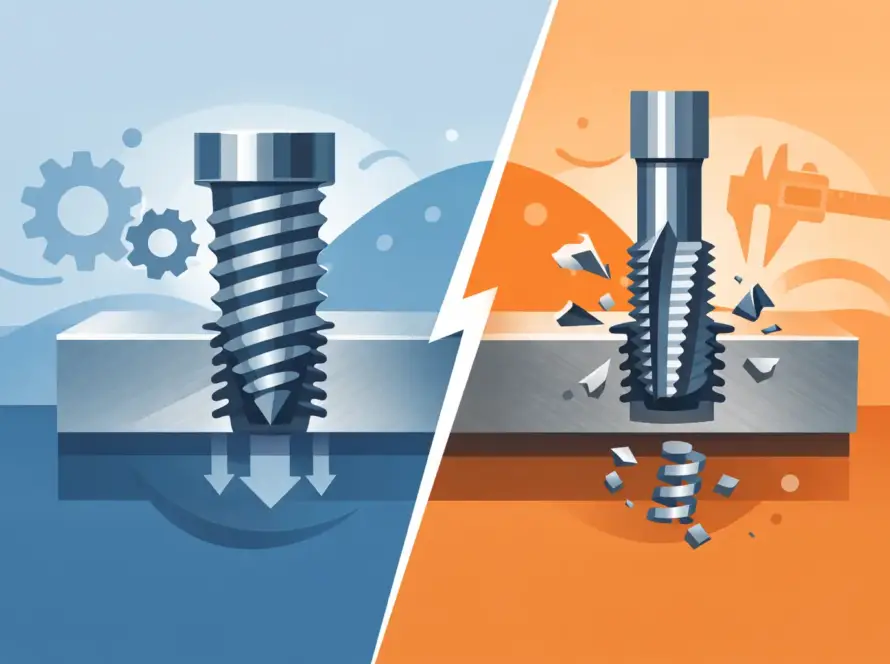
A joint that passes torque audit at the station and fails in the field usually did not fail because of torque alone. It failed because clamp load varied more than the process allowed. That is why assembly torque consistency methods matter in real production – not as a quality slogan, but as a practical way to control joint performance, reduce rework, and prevent premature loosening, cracking, or thread damage.
In high-volume assembly, torque is often treated as the easiest measurement to capture. It is fast, familiar, and compatible with manual tools, DC electric systems, pulse tools, and automated stations. But torque is only an indirect indicator of preload. Friction at the thread flank, underhead bearing surface, coating condition, part geometry, and installation speed all influence the final result. Two joints can reach the same torque and deliver very different clamp loads. Any serious approach to consistency starts with that reality.
Why assembly torque consistency methods fail when the joint is not understood
The first process mistake is trying to standardize torque without defining the joint itself. A screw into steel behaves differently than a thread-forming screw into thermoplastic. A flange bolt on painted steel behaves differently than a captive screw in a thin sheet stack-up. Material compression, embedment, relaxation, and prevailing torque all change what the tool sees during rundown.
For that reason, the target should never be a torque number in isolation. The target is repeatable joint performance within the actual application window. In some assemblies, that means preventing self-loosening under vibration. In others, it means avoiding creep in plastics, stripping in light alloys, or distortion in thin components. The right torque strategy depends on the failure mode you are trying to avoid.
This is also where design and manufacturing need to stay aligned. If engineering specifies an aggressive clamp requirement but the selected fastener, coating, boss design, or tool capability cannot hold a tight installation range, production inherits an unstable process. Consistency is not fixed at the line after the fact. It is engineered upstream.
Core assembly torque consistency methods used in production
The most effective torque control methods combine joint design, fastener selection, tool strategy, and process verification. Relying on only one of those usually creates hidden variation.
Match the fastener to the substrate and joint function
Consistency starts with using a fastening system designed for the base material and load case. A generic machine screw, thread-forming screw, or anti-vibration bolt may all fit dimensionally, but they will not produce the same installation behavior. In plastics, for example, thread geometry directly affects stripping margin, insertion torque, and long-term retention. In high-vibration metal assemblies, prevailing torque features or mechanical locking designs can stabilize performance where standard screws cannot.
Drive system choice matters as well. Better bit engagement reduces cam-out risk, improves torque transfer, and lowers assembly variability caused by inconsistent operator alignment. Underhead geometry, washer integration, and SEMS configurations can also improve seating consistency when part handling or stack-up movement is part of the problem.
Control friction, because friction controls torque scatter
A large portion of applied torque is consumed by friction rather than converted into clamp load. That means any change in surface condition can create major variation. Zinc flake coatings, oil residues, phosphate finishes, patch locking elements, paint overspray, and mating surface roughness all affect the torque-tension relationship.
This is where many otherwise capable lines lose control. Procurement sources an equivalent-looking fastener from a different lot or finish supplier, and torque values stay the same while clamp load shifts. The process appears stable until failures show up downstream. If torque consistency is critical, friction-sensitive characteristics must be specified and managed, not treated as secondary details.
In practice, that means validating the as-received fastener condition, the mating part finish, and any lubrication state used in production. It also means avoiding uncontrolled hand-applied lubricants or mixed inventories that introduce variation station by station.
Use the right tightening strategy for the joint
Not every joint should be tightened with a simple shutoff-at-torque approach. Torque control is common and often sufficient, but certain assemblies benefit from torque-angle, yield-based tightening, or multi-step rundown strategies. The more sensitive the joint is to friction variation, the more valuable an advanced tightening method can be.
Torque-angle strategies can improve repeatability after seating by tracking rotation as the joint transitions into elastic clamp loading. They are especially useful when the seating condition is well defined and the fastener and material system support predictable behavior. That said, they require a more stable joint signature than many soft joints or plastic assemblies can provide.
For soft materials, gasketed joints, or thread-forming applications, installation speed and dwell can matter almost as much as final torque. A slower, controlled seating phase may reduce overshoot and material damage. In plastics, staged tightening can reduce local stress and improve long-term retention, but only if validated against creep and relaxation behavior.
Standardize tool performance and maintenance
Even the best fastening specification will drift if the tool system is not controlled. Manual clutch tools, pneumatic nutrunners, pulse tools, and servo-driven DC tools each have strengths and limitations. The correct choice depends on torque level, access, cycle time, traceability needs, and required process capability.
A common error is expecting a general-purpose tool to hold a tight torque window across multiple joint types. Tool output is influenced by calibration, wear, reaction conditions, socket fit, battery state in cordless systems, air supply quality in pneumatic systems, and operator technique. If a station is producing inconsistent results, the root cause is often the interaction between the tool and the joint, not either one by itself.
Preventive maintenance, transducer verification, and periodic capability checks are essential. So is tooling standardization across shifts and lines. If one station uses a different extension, socket depth, or reaction arm setup, measured consistency can erode fast.
Measuring consistency the right way
A torque audit alone does not prove a capable fastening process. Residual torque testing can be useful for screening, but it does not directly measure achieved preload and can be misleading if used as the main quality metric. More reliable process control comes from understanding installation data in context.
For critical joints, the best approach often includes a combination of dynamic rundown data, torque-angle signature review, joint testing, and periodic torque-tension correlation studies. This is where advanced tools and engineered fastening support add real value. You want evidence that the process can repeatedly produce the required joint outcome, not just a passing number at the end of the cycle.
Cp and Cpk analysis can help, but only after the torque window itself is technically justified. A very capable process centered on the wrong target is still a bad process. Statistical control works only when the engineering basis is sound.
Operator, automation, and part presentation effects
Human factors remain relevant even on highly engineered lines. Operator posture, visibility, bit replacement discipline, and part presentation all influence fastening consistency. Cross-thread starts, incomplete seating, side loading, and poor alignment create variation before the tool ever reaches final torque.
Automation reduces some of that variation, but not all of it. Automatic screw feeding, nosepiece alignment, and programmed rundown logic can improve repeatability, yet automation also introduces its own failure modes. Misfeeds, worn escapements, skipped cycles, and fixture tolerance stack-ups can all distort the fastening result.
The strongest assembly torque consistency methods treat the station as a system. That includes fixture design, component access, screw delivery, reaction management, and poka-yoke controls where appropriate. If the assembly setup allows bad starts or unstable seating, tool precision alone will not solve it.
Where fastener engineering makes the biggest difference
When manufacturers struggle with recurring torque scatter, they often first look at calibration frequency or operator training. Those are valid checks, but repeated variation is frequently designed into the joint through the wrong fastener, the wrong thread engagement, or an unstable bearing surface.
This is where an engineering-oriented supplier can materially improve performance. Adjusting thread form for plastics, specifying a coating with tighter friction behavior, integrating a captive or SEMS configuration, or selecting an anti-loosening design for vibration service can tighten process variation and improve assembly efficiency at the same time. KEBA Fastenings works in that space – where the right component specification supports both production control and long-term joint reliability.
The practical standard is simple. If torque variation is causing stripped threads, inconsistent clamp, vibration loosening, or costly rework, the process needs more than a tighter inspection plan. It needs a better-matched fastening system, a validated tightening method, and production controls built around the actual joint. Get those three aligned, and consistency stops being a daily correction exercise and starts becoming part of the design.