A line stoppage over a 12-cent fastener is rarely about the fastener alone. It usually starts earlier – with an incomplete drawing, a material mismatch, an overlooked coating issue, or a supplier chosen on unit price without enough attention to application risk. That is why a custom fastener sourcing case study matters to procurement teams and engineers alike. It shows how part design, manufacturing capability, quality planning, and supply continuity have to work together if the assembly is expected to perform in the field.
This example reflects a common sourcing scenario in industrial manufacturing: a North American OEM needed a fastening solution for a high-vibration equipment assembly built from mixed materials, including coated steel brackets, light alloy housings, and molded polymer covers. The original bill of materials relied on a mix of standard screws, washers, and prevailing torque nuts sourced from multiple vendors. On paper, the arrangement was serviceable. In production and field use, it created avoidable cost, inconsistency, and failure risk.
The sourcing problem behind the part number
The OEM was facing three issues at the same time. First, assembly operators were dealing with too many loose components at the station. A screw, two washers, and a nut meant more handling, more chances for misbuild, and slower cycle times. Second, field returns showed intermittent loosening in vibration-heavy operating conditions. Third, procurement had little protection against supply disruption because several components came from different suppliers with different lead times and quality controls.
None of these problems was unusual on its own. The challenge was that they interacted. A fastening stack-up that slows assembly also increases the chance of installation variation. A supplier base that is too fragmented makes engineering change control harder. A low-cost standard fastener can become expensive once rework, warranty exposure, and line-side complexity are counted honestly.
The OEM did not need a commodity replacement. It needed an engineered sourcing approach that addressed joint performance and supply stability together.
Custom fastener sourcing case study: the evaluation phase
The first step was not quoting. It was application review. That distinction matters because many sourcing failures happen when purchasing activity gets ahead of technical validation.
The joint requirements were mapped against actual operating conditions: clamp load expectations, vibration exposure, substrate material behavior, coating compatibility, installation torque window, and assembly method. The polymer cover also raised a separate issue. A standard machine screw solution created inconsistent thread engagement in the molded component, while an alternate self-tapping geometry offered better retention and repeatability when matched correctly to the plastic.
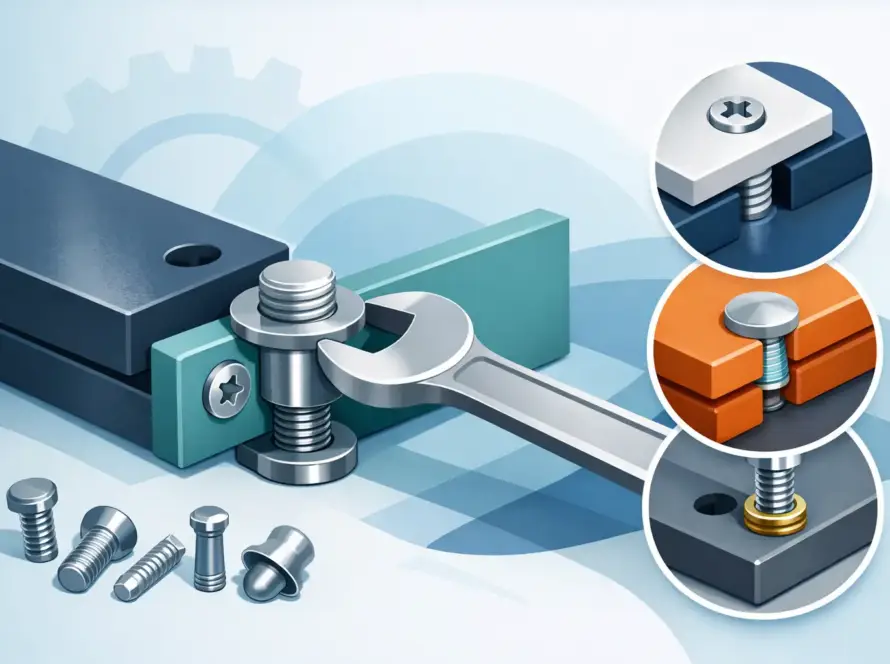
At the same time, the bracket-to-housing joint needed improved anti-loosening performance without adding labor at assembly. Adhesive patch options were reviewed, but temperature exposure and storage control introduced complications. A mechanical anti-vibration bolt design with a captive element and controlled locking feature offered a better fit for the use case.
This is where custom sourcing becomes materially different from simply buying special prints. The job is not only to manufacture a nonstandard part. It is to identify which variables should be standardized, which should be customized, and where overengineering adds cost without adding value.
What changed in the specification
The original four-piece joint at one station was redesigned into a pre-assembled fastener solution using a SEMS-style configuration for one assembly point and a captive anti-vibration fastener for another. In the polymer area, the thread-forming screw geometry was revised for the actual resin and wall thickness rather than carried over from an earlier program.
Material and finish selection were tightened as well. The previous specification allowed a broad equivalent range that looked flexible from a sourcing standpoint but created variability in corrosion behavior and prevailing torque performance. The revised print narrowed the accepted material grade, hardness band, and coating system. That reduced interchangeability across low-control sources, but it improved process consistency and field confidence.
There is always a trade-off here. Tighter specifications can reduce the apparent number of eligible suppliers. But if the original flexibility is causing variation in torque-tension response or coating performance, broad sourcing freedom is not a real advantage.
Supplier alignment and manufacturing review
A good custom fastener sourcing case study is rarely won at the drawing level alone. Supplier capability review is where many projects either stabilize or drift.
In this case, manufacturing feasibility was checked before final release. That included heading limits, secondary operation requirements, thread rolling feasibility, washer retention performance for the assembled screw, and coating process implications for dimensional control. Packaging was also reviewed because the customer needed line-ready delivery that protected pre-assembled components from damage and reduced sorting at the point of use.
Quality planning focused on the characteristics that actually mattered in the assembly. Instead of creating paperwork-heavy inspection on every dimension, the control plan emphasized thread geometry, locking feature performance, assembled retention, coating thickness, and torque-related functional checks. For OEMs and Tier suppliers, this matters. A stack of generic inspection data does not help if the part still behaves inconsistently during installation.
One advantage of working with an engineering-led fastening supplier is that design intent and production reality are assessed together. A custom part that looks efficient in CAD can become expensive or unstable if it requires too many secondary operations, too little process margin, or excessive manual inspection.
The logistics piece most teams underestimate
The sourcing fix was not complete until logistics were addressed. The customer had been managing separate purchase orders, safety stocks, and receiving processes for multiple fastening components tied to the same assembly. That created hidden administrative cost and raised the risk of shortages on low-value items that could still stop production.
By consolidating the fastening package and introducing stock-based supply planning for the new part numbers, the OEM reduced line-side complexity and improved replenishment visibility. Forecasting did not become perfect, but it became more manageable because there were fewer independent variables.
This is often where sourcing strategy becomes measurable. Unit price can go up slightly on a custom engineered fastener while total installed cost goes down. Fewer touches, lower misbuild risk, reduced part-count complexity, and more stable supply all have financial value, even if they do not appear in the first comparison spreadsheet.
Results from the custom fastener sourcing case study
After implementation, the OEM saw improvement in three areas that mattered operationally.
Assembly efficiency improved because operators handled fewer loose components and spent less time correcting incomplete installations. Quality performance improved because the revised fastener geometry and locking design reduced variation in the joint. Supply management improved because procurement was no longer chasing several vendors for one functional fastening system.
The most important result, however, was risk reduction. The sourcing model moved from reactive purchasing to controlled application support. That shift tends to have a larger long-term payoff than any single piece-price negotiation.
What this case shows for procurement and engineering teams
There are a few clear lessons in this type of project. First, fastening should be evaluated as part of assembly performance, not as isolated hardware. Second, standard parts are not automatically the lowest-cost option when they create extra handling, quality escapes, or field failures. Third, supplier selection for custom fasteners should include engineering support, manufacturing control, and logistics capability – not just quote speed.
For some applications, a standard catalog part is still the right answer. If the joint is low risk, the environment is controlled, and sourcing alternatives are abundant, customization may add unnecessary complexity. But in vibration-prone assemblies, mixed-material joints, plastic applications, or high-volume production environments, the economics change quickly.
That is where an industrial partner with product depth across self-tapping screws, anti-vibration bolts, captive screws, SEMS assemblies, compression limiters, and related engineered components can provide more than fulfillment. KEBA Fastenings operates in exactly that space, where the right fastening system has to satisfy both design intent and production reality.
The practical takeaway is straightforward. If a fastener keeps showing up in warranty claims, assembly delays, or sourcing escalations, the issue is probably not just availability. It is likely an application problem disguised as a purchasing problem. Solving it well starts with asking better technical questions before the next quote goes out.