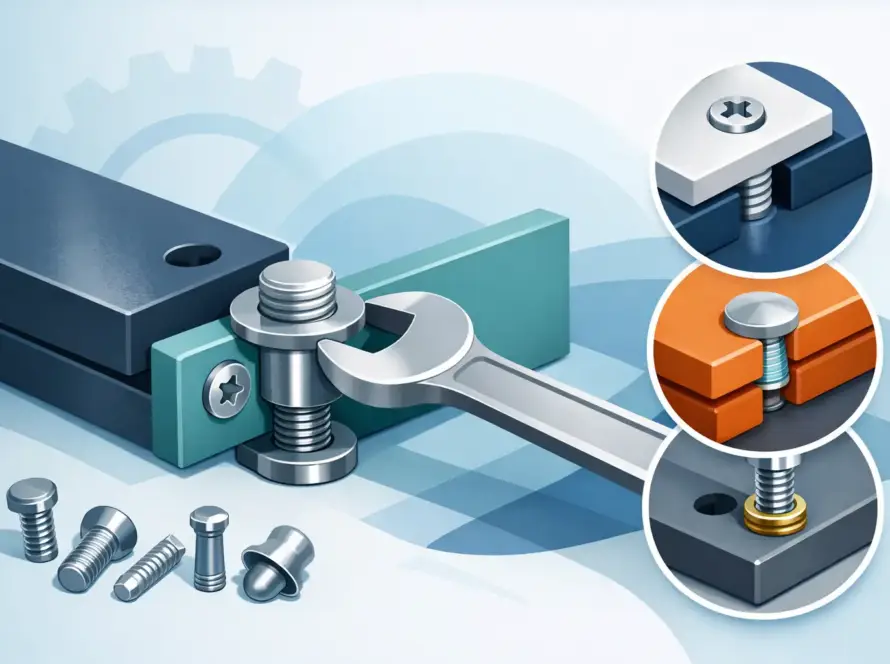
A plastic boss that looks fine at incoming inspection can fail in seconds on the assembly line. The driver spins, clamp load drops, and now the joint is inconsistent, the part may be scrap, and rework starts eating time. If you are asking why do screws strip in plastics, the short answer is that plastic does not fail like metal. It deforms, creeps, heats quickly, and has much less margin for poor thread design or uncontrolled installation.
That answer matters because stripped plastic threads are rarely caused by one issue alone. In most manufacturing environments, the failure comes from the interaction between screw geometry, plastic properties, hole design, and installation parameters. If one of those variables is out of range, the thread can shear, the boss can crack, or the screw can simply overrun the material before the required clamp load is reached.
Why do screws strip in plastics during assembly?
In plastics, stripping happens when the material surrounding the screw thread can no longer resist the torsional and axial loads created during installation. Unlike steel or aluminum, most thermoplastics have lower shear strength and lower modulus. They also respond strongly to temperature, strain rate, and localized stress. That means the window between proper thread forming and thread failure can be narrow.
A common mistake is treating a plastic joint like a metal joint. If the fastening strategy assumes the material can tolerate high seating torque, aggressive thread engagement, or repeated assembly cycles without degradation, stripping becomes much more likely. Plastic needs a fastening system engineered around its behavior, not just a smaller version of a metal fastener approach.
The plastic itself may be the limiting factor
Not all plastics carry threads equally well. Unfilled polypropylene, ABS, and some commodity resins can be forgiving in molding but less resistant to thread shear. Glass-filled materials may offer better strength, but they can also become less ductile and more sensitive to stress concentration. Thermosets behave differently again, often requiring screw designs tailored to their lower elongation and distinct fracture behavior.
Moisture content, molding conditions, and part age also matter. Nylon is a familiar example. Its mechanical performance changes with conditioning, which can alter installation torque and thread retention. If process validation was done on dry parts and production sees conditioned parts, or the reverse, results can shift enough to create stripping issues.
Pilot hole size drives thread quality
Hole diameter is one of the biggest variables in plastic thread performance. If the pilot hole is too large, the screw cannot generate enough thread engagement and the material strips before clamp load builds. If the hole is too small, installation torque rises sharply, radial stress increases, and the boss may crack or the material may be overworked during thread forming.
This is where many failures begin. Teams often focus on screw diameter and overlook the fact that a few thousandths of an inch in hole size can materially change strip-out torque and assembly consistency. Mold variation, tool wear, shrink rate, and part cooling all influence the final hole dimension. A nominally correct design can still fail if the molded reality drifts out of tolerance.
Boss design can create a weak joint before the screw is installed
A screw only performs as well as the plastic feature receiving it. Thin wall sections, insufficient boss outer diameter, poor support ribs, knit lines, sink-related geometry compromises, and short engagement depth all reduce stripping resistance. If the boss is under-designed, no installation adjustment will fully solve the problem.
Stress concentration is especially relevant. Sharp transitions at the base of the boss or poorly blended ribs can cause crack initiation during thread forming. Once the plastic begins to split or craze locally, the thread loses its load-bearing structure. The operator may see this as a stripped thread, but the root cause is often geometric weakness rather than screw failure.
Screw design is often the difference between controlled forming and stripped threads
Standard machine screws are a poor choice for direct installation into most plastic bosses unless a metal insert is being used. Plastics typically require thread-forming screws designed to displace material efficiently and reduce installation stress. The thread profile, pitch, flank angle, and point geometry all influence how the material flows during installation.
A screw intended for thermoplastics usually has a geometry that forms threads with lower radial stress than a generic fastener. That improves assembly consistency and helps preserve boss integrity. By contrast, an unsuitable screw can act more like a wedge than a forming tool, which raises torque demand and accelerates stripping.
Drive system and bit condition matter more than many teams expect
When the recess cams out, wobbles, or transfers torque inconsistently, the installation process becomes harder to control. Operators or automated tools may compensate by increasing force or extending rundown time, which can damage the newly formed plastic thread. Poor bit fit also distorts torque data, making process limits less reliable.
For production environments that need repeatability, the drive system should support stable engagement and precise torque transfer. Worn bits, poor alignment, or mismatched recess geometry add variation that the plastic joint usually cannot absorb.
Process settings can strip a good design
Even with the right screw and a sound boss, assembly settings can still cause failure. High driver speed is a frequent problem. Faster installation increases frictional heat at the thread interface, and many plastics soften quickly under localized heating. As the material softens, the screw can overrun the formed thread and strip it before the tool reaches its target.
Torque control also has limits in plastic applications. If the process relies only on final torque without accounting for seating behavior, thread forming torque and clamp load development can be misread. In some cases, a torque value that looks acceptable on paper is already beyond the strip threshold for a specific resin or boss geometry.
A more stable process may require controlled speed in the thread-forming phase, a lower seating speed near final clamp, and verification of prevailing torque versus strip torque margin. If the strip torque is too close to the installation torque, the process will remain sensitive to normal variation.
Repeated assembly reduces thread life
Plastic threads formed directly by screws are not ideal for unlimited reuse. Every removal and reinstallation cycle wears the formed thread and reduces engagement quality. If the application involves service access, field maintenance, or repeated disassembly in production, direct-to-plastic fastening may not be the right long-term choice.
This is where inserts or alternative joint strategies deserve consideration. They add cost and process steps, but in high-cycle or serviceable applications they may lower total cost by reducing damage, scrap, and field failures.
How to reduce stripping risk in plastic joints
The most effective fix is usually not a higher torque setting or a larger screw. It is a matched system – resin, boss geometry, pilot hole, screw design, and installation method engineered together.
Start with the application requirements. Determine whether the joint is one-time assembly, limited reuse, or serviceable over many cycles. Then evaluate the plastic grade and the molded hole capability, not just the CAD nominal. Measure actual parts across production conditions. If the hole size distribution is wide, the fastening process will be wide too.
Next, verify that the screw is designed for the specific plastic family. Thermoplastics and thermosets do not respond identically, and filled materials can shift the optimum geometry. Engagement length, boss outer diameter, and support features should be checked against the expected strip-out requirement, not simply copied from prior programs.
Process validation should include real strip torque testing, not only installation torque studies. The goal is a practical safety margin between normal assembly torque and thread failure torque across lot variation. If that margin is too small, the joint is living on borrowed time.
For high-volume manufacturing, tool setup deserves the same attention as part design. Speed, downforce, alignment, depth control, and bit condition all affect outcomes. A well-engineered fastener can still fail in a poorly controlled station.
At KEBA Fastenings, this is typically where the largest gains are made – not by treating stripped threads as an operator issue, but by engineering the fastening system around the plastic, the part geometry, and the production environment.
Why do screws strip in plastics even when the print looks correct?
Because prints do not capture the full assembly reality. Mold shrink variation, resin lot changes, conditioning, cycle time pressure, driver wear, and tolerance stack-up all influence how the thread forms. A design that is technically acceptable can still be operationally weak if it leaves too little margin between installation torque and strip torque.
That is why stripped plastic joints should be treated as an engineering problem, not just a quality defect. The right question is not whether the screw went in. The right question is whether the joint can be formed repeatedly, at production speed, with consistent clamp load and without damaging the substrate.
When plastic fastening is designed with that level of discipline, stripping becomes far less common. And when it does appear, it is usually a signal worth investigating early – before a small assembly issue turns into a warranty, downtime, or throughput problem.
If your plastic joint is stripping, the fastest path forward is usually a more specific one: match the fastener to the material, validate the boss and hole as molded, and make sure the assembly process is working with the plastic rather than against it.