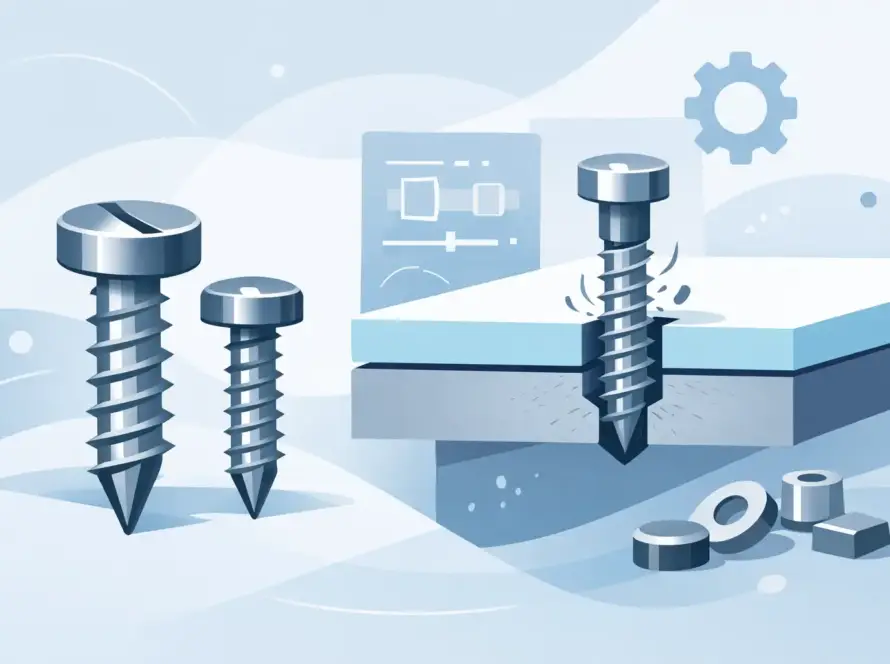
A failed joint on a pump skid or wellhead assembly is rarely traced back to “just a bolt” for long. In oil and gas service, fastening failure usually points to a specification gap – wrong material, poor locking method, preload loss, thread damage, or a design that did not account for vibration, corrosion, and maintenance cycles. That is why fasteners for oilfield equipment need to be treated as engineered components, not commodity hardware.
What makes oilfield fastening different
Oilfield equipment puts fasteners under combined stresses that are difficult to manage with standard off-the-shelf selections. Assemblies may face cyclic loading, shock, thermal expansion, corrosive media, mud, salt exposure, and repeated service access. On top of that, many joints are part of safety-critical systems where loss of clamp load can affect sealing, alignment, or structural integrity.
The challenge is not simply high strength. In many cases, a harder or stronger fastener can create a different problem, such as reduced toughness, galling risk, or mismatch with the connected materials. A fastening system for a drilling rig subassembly, valve package, enclosure, or control module has to balance mechanical load, environmental resistance, installation repeatability, and field serviceability.
This is where specification discipline matters. The correct choice depends on the application, the base materials, the expected maintenance interval, and the failure mode that must be prevented.
Key performance requirements for fasteners for oilfield equipment
The first requirement is clamp load retention. Many field failures begin when vibration, embedment, temperature cycling, or joint relaxation reduces preload. Once clamp load drops, the joint starts to move. That movement increases wear, enlarges holes, damages threads, and accelerates loosening.
Corrosion resistance is equally critical, but corrosion is not one single condition. Some equipment sees offshore salt spray. Some sees sour service, aggressive chemicals, or washdown exposure. Others operate in enclosed systems where condensation and temperature swings drive localized corrosion. Material and coating choices have to match the real service environment, not the assumed one.
Thread integrity also matters more than many specifications reflect. Field assembly often happens under time pressure, sometimes with contamination present and access limitations affecting tool alignment. If the drive system strips easily, or if thread engagement is too short for the load path, installation quality becomes inconsistent.
Then there is vibration resistance. Rotating equipment, mobile units, compressors, pumping systems, and engine-driven assemblies all create dynamic loading. In these conditions, standard nuts and bolts without a proven anti-loosening strategy may perform acceptably in static tests and still fail in service.
Material selection is application-specific
Carbon steel fasteners are still used widely, but they are not universal answers. Where corrosion exposure is moderate and cost control is a major factor, properly specified plated or coated steel can be appropriate. The limitation is that coatings have service boundaries, and damage during installation can reduce protection.
Stainless steel offers better corrosion resistance in many environments, especially for external assemblies, instrument housings, and hardware exposed to weather or washdown. But stainless is not automatically the safer choice. Depending on grade and loading, it can introduce galling concerns, and in some aggressive environments the wrong stainless alloy will underperform.
High-strength alloy steel may be required where joint loads are high and dimensional constraints limit fastener size. Yet higher strength classes need careful review against fracture toughness, environmental cracking risk, and tightening procedure. In oilfield applications, material selection should always be tied to actual service conditions, not purchasing convenience.
For mixed-material assemblies, galvanic interaction has to be considered. Light alloys, coated steels, stainless hardware, and dissimilar inserts can create corrosion pathways that shorten service life. This is especially relevant in housings, control enclosures, and lightweight modular equipment where aluminum and stainless often meet.
Locking methods that actually match field conditions
There is no universal anti-loosening method for oilfield service. The right approach depends on vibration severity, disassembly needs, temperature, and available installation control.
Prevailing torque nuts can work well in many equipment assemblies, particularly when repeated micro-movement is the main threat. Mechanical locking features are often preferred where contamination, fluids, or temperature may reduce the reliability of chemical threadlockers.
Thread-form locking elements and specialized anti-vibration bolts are worth considering where dynamic loading is persistent. These solutions are designed to maintain clamp load more effectively than plain fasteners in joints subject to cyclical stress. For OEMs trying to reduce loosening-related maintenance, they often provide a better long-term answer than simply increasing torque.
Captive screws can also add value in service-access panels, electrical housings, and inspection covers. Their benefit is not higher strength. It is controlled retention, faster maintenance, and lower risk of dropped hardware in field conditions.
Where washers, screws, and other elements are frequently assembled together, pre-assembled SEMS configurations can improve installation consistency and reduce handling time. That matters in production, and it also helps when service teams need repeatable assembly procedures in less-than-ideal environments.
Joint design matters as much as the fastener itself
A high-performance fastener cannot compensate for poor joint design. If the joint stack is too soft, if the clamped parts embed heavily under load, or if the grip length is poorly proportioned, preload loss can happen even with a premium fastener.
Compression limiters are one example of a component that can protect joint integrity in assemblies that include plastics or softer materials. They allow controlled tightening without crushing the substrate, which is especially useful in housings, connectors, and hybrid assemblies used on equipment exposed to outdoor conditions.
Thread engagement must also be evaluated carefully. In softer materials or cast components, designers may need inserts, larger engagement depth, or a different thread strategy to maintain stripping resistance. Self-tapping screws can be effective in thermoplastics and thermosets, but they have to be selected around material behavior, wall thickness, and service loads.
For sheet metal structures, stamped brackets, guards, and secondary assemblies, the challenge is often balancing speed of assembly with long-term durability. Here, locking nuts, formed threads, and application-specific screw geometries can improve both line efficiency and in-service retention.
Manufacturing and supply considerations
Procurement teams know that the correct specification on paper is only half the job. Fasteners for oilfield equipment also need stable quality, traceability where required, and dimensional consistency that supports repeatable torque-tension performance.
This is where supplier capability becomes part of the engineering decision. If a project needs a standard part with dependable stock support, that is straightforward. If it requires a modified head design, special coating, pre-applied locking feature, captive configuration, or a turned and stamped combination part, the supplier has to support both technical validation and production fulfillment.
For OEMs and industrial equipment builders, logistics can be as important as design support. Stock-based supply, kitting, and customer-specific manufacturing reduce line disruption and simplify sourcing for multi-part assemblies. A supplier such as KEBA Fastenings adds value when it can align product selection, engineering input, and supply continuity rather than treating each fastener as an isolated line item.
Common specification mistakes
One common mistake is selecting by tensile strength alone. A stronger bolt does not automatically create a stronger joint if preload is uncontrolled or the connected materials relax under load.
Another is overlooking installation conditions. If technicians cannot access the fastener with proper alignment, or if the drive recess is prone to cam-out, assembly quality will vary. Drive-system selection affects torque transfer, tool wear, and damage risk more than many specifications acknowledge.
A third mistake is treating corrosion protection as a coating question only. In reality, coating, substrate, environment, and mating materials all interact. The result can be acceptable service life or accelerated failure, depending on the full system.
Finally, many teams underestimate the cost of maintenance-driven hardware problems. A joint that loosens occasionally may look like a minor issue in procurement terms, but in field service it can mean downtime, inspection cost, and repeated labor.
How to specify with fewer failure points
Start with the joint function. Is the fastener providing structural clamping, maintaining a seal, retaining a cover, or attaching a component to a mixed-material housing? Then define the real service environment, including vibration, temperature, fluid exposure, and maintenance frequency.
From there, evaluate material, coating, locking method, drive system, and assembly process as one system. If the application includes plastics, thin sheet, light alloys, or repeated service access, account for those variables early. It is usually more effective to design out loosening and installation variation at the specification stage than to chase failures after release.
The most dependable fastening decisions in oilfield equipment are rarely the most generic ones. They come from matching joint design, material behavior, and assembly realities with a fastening solution built for the job. When that happens, the result is not just a tighter joint. It is better uptime, more predictable maintenance, and equipment that performs the way it was engineered to perform.
The best time to solve a fastening problem is before it reaches the field, when specification choices are still flexible and failure is still inexpensive.