A bolted joint rarely fails without warning. More often, it loses clamp load gradually, starts to move under service loads, and then turns into noise, wear, leakage, misalignment, or a full field failure. If you are evaluating how to prevent fastener loosening, the real question is not just which locking feature to specify. It is how the entire joint behaves under vibration, thermal cycling, embedment, side load, and material relaxation.
In industrial assemblies, loosening is usually a system problem rather than a single-part problem. Fastener geometry matters, but so do joint stiffness, surface condition, torque control, substrate material, and the way the assembly is loaded in service. The most reliable approach is to treat anti-loosening performance as a design and process requirement from the start.
How to prevent fastener loosening starts with clamp load
Most threaded joints resist loosening because the fastener stretches and creates clamp force. That clamp force holds the joint members together through friction. When the clamp load is high enough and remains stable, the joint resists relative movement. When clamp load drops, even a well-selected screw or nut can begin to rotate loose under transverse vibration.
This is why torque value alone can be misleading. Torque is only an indirect method of creating preload, and a large share of applied torque is lost to friction under the head and in the threads. If friction varies because of coatings, lubrication, plating, or surface finish, preload can vary significantly even when the torque wrench reads the same number.
For critical joints, the target should be consistent preload, not just a nominal torque setting. In some applications, prevailing torque locknuts, flange designs, hardened washers, or direct-tension control methods improve consistency. In others, especially in plastics or light alloys, too much preload can damage the joint long before it improves retention. That is where material-specific fastener selection becomes essential.
Why fasteners loosen in real operating conditions
Vibration gets the most attention, but it is only one mechanism. Repeated transverse loading can cause microscopic slip at the joint interface. Once that slip starts, clamp load falls and thread rotation becomes easier. This is common in rail, off-highway equipment, rotating machinery, and vehicle assemblies.
Embedment is another frequent issue. Surface roughness, coatings, and contact points flatten after installation, especially in stacked joints with multiple interfaces. The result is preload loss shortly after assembly. Softer materials such as aluminum, copper alloys, composites, and plastics are more vulnerable.
Thermal cycling also changes joint behavior. If the fastener and clamped materials expand at different rates, preload can rise or fall as temperatures change. In high-temperature systems, relaxation and creep may reduce clamp force over time. In cold-to-hot operating cycles, what works on the assembly line may not hold in service.
Then there is joint design itself. If the fastener is carrying shear because the joint members are moving against each other, or if the grip length is too short, the assembly becomes more sensitive to loosening. A joint that depends on the screw shank to resist movement instead of friction between clamped parts is usually harder to stabilize.
Joint design choices that reduce loosening risk
A more stable joint starts with stiffness and load path. In general, longer grip lengths improve elastic stretch in the fastener and help preserve clamp load. Short, rigid joints can be more prone to preload loss because a small amount of settlement has a larger effect.
The interface matters just as much. Wider bearing surfaces, flange heads, or appropriate washers can improve load distribution, but washers are not automatically beneficial. A soft or poorly selected washer can increase settlement. A hardened washer under a high-strength bolt can protect the joint surface and reduce embedment, while the wrong washer can become another source of preload loss.
Alignment matters as well. If the joint is exposed to bending or side loading because of poor fit-up, loosening becomes more likely. Features such as dowels, sleeves, compression limiters, or better hole tolerances can shift shear loads away from the threads and back into the structure where they belong.
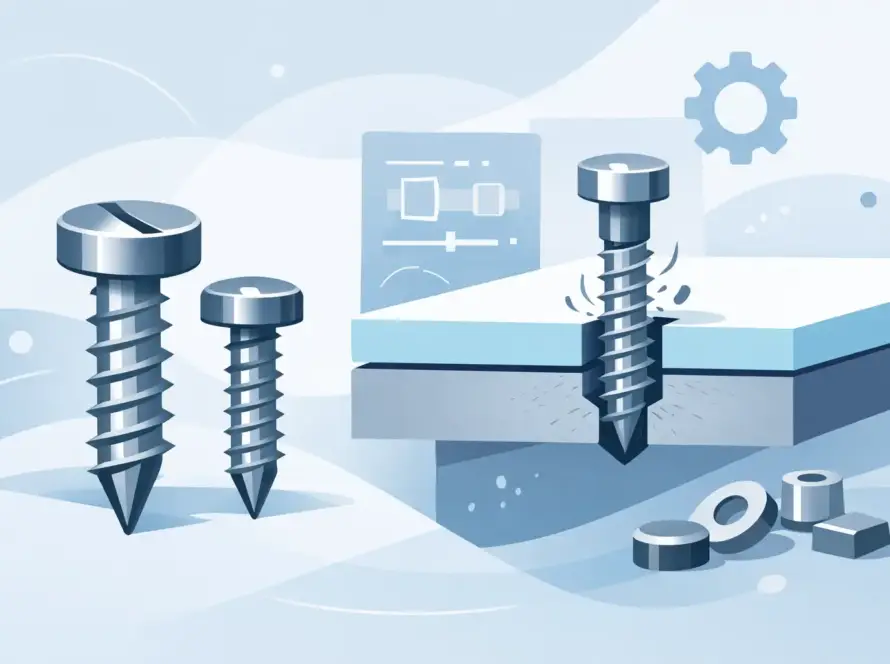
For plastics and other low-modulus materials, standard machine screw practice often produces weak long-term results. Thread-forming screws designed for thermoplastics or thermosets create more reliable engagement, reduce installation damage, and improve retention when used with the right boss geometry. In these assemblies, preventing loosening is as much about managing creep and stripping risk as it is about resisting vibration.
Locking methods and when each one works
There is no single best locking method for every application. The correct choice depends on service load, disassembly requirements, material compatibility, installation speed, temperature, and whether the joint must be reused.
Prevailing torque locknuts are effective where repeated vibration is expected and where controlled resistance to rotation is needed. All-metal versions perform well at elevated temperature, while polymer-insert styles may be limited by heat and chemical exposure. Their advantage is predictable anti-rotation performance without adhesives, but they do add installation torque and may have reuse limitations.
Mechanical locking features such as serrated flanges, wedge-locking systems, or captive locking elements work well when vibration resistance and serviceability are both required. These solutions can be strong in maintenance-intensive equipment, but they need the right bearing surface and installation practice to deliver the intended result.
Threadlocking adhesives can be highly effective when the joint is properly cleaned and the operating environment suits the chemistry. They help fill thread gaps and resist self-loosening, but curing time, contamination, service temperature, and future disassembly all need to be considered. In high-volume production, process control becomes critical.
For severe vibration, purpose-built anti-vibration bolts and locking nuts often outperform generic hardware because their geometry and locking function are engineered around dynamic loading rather than static clamp alone. That distinction matters in applications where the joint sees repeated shock, motion, or cyclic side load.
How to prevent fastener loosening in plastics and light alloys
This is where many assemblies fail early. Plastics creep under sustained load, and light alloys are more susceptible to thread damage, embedment, and preload loss than hardened steel joints. If the fastener was chosen using metal-to-metal assumptions, field performance can be disappointing.
Use fasteners engineered for the substrate. In thermoplastics, thread-forming screws with optimized flank geometry reduce radial stress and improve long-term retention. In thin or soft materials, compression limiters can prevent over-compression and preserve clamp load across the life of the assembly. In light alloys, engagement length, head bearing area, and torque window need tighter control.
Captive screws and SEMS assemblies can also improve consistency by reducing handling errors and ensuring the right washer or spacer stays with the fastener. That may seem like an assembly efficiency issue, but it also affects loosening because repeatable installation produces more repeatable preload.
Process control is often the missing piece
A sound joint design can still fail if installation is inconsistent. Tool calibration, torque-angle strategy, surface cleanliness, operator training, and part presentation all affect final clamp load. If one shift applies dry screws and another installs lubricated parts, the joint is not being built to the same condition.
For high-volume manufacturing, it is worth validating the complete tightening process, not just the drawing note. Measure actual preload where possible, confirm rundown behavior, and test under realistic vibration and thermal conditions. Junker-style vibration testing, thermal exposure, and repeated service-cycle validation provide better data than static bench torque checks alone.
Procurement also plays a role. Substituting nominally equivalent fasteners can change friction, hardness, thread tolerances, and coating thickness enough to alter performance. That is one reason many OEMs work with suppliers that can support both specification discipline and application-specific recommendations. A company such as KEBA Fastenings typically adds value by aligning product selection, manufacturing quality, and logistics support around joint performance rather than part-price alone.
A practical specification mindset
If you want better anti-loosening performance, specify the joint as a functional system. Define the substrate, load direction, vibration level, thermal range, service interval, reuse expectation, and installation controls. Then match the fastener, locking method, and tightening process to those conditions.
That approach may lead to a different answer for each application. A railway panel, a gearbox housing, a plastic electronics enclosure, and a hot bolted flange do not loosen for the same reasons, so they should not be treated with the same generic fix. The most reliable assemblies are usually the ones where clamp load, material behavior, and locking strategy were engineered together from the start.
The best time to solve loosening is before the first production run, when a small change in fastener design or joint architecture can prevent years of maintenance, warranty cost, and avoidable downtime.